Welcome back to Innovation Download, our monthly look at the news and ideas shaping the Australian startup ecosystem.
This month’s Innovation Download is about discovery: how do customers find you in the age of AI? Fewer of them are searching and more of them are asking. Google now answers a growing share of questions itself with AI Overviews, and a growing number of Aussies skip Google entirely and ask ChatGPT, Gemini or Claude what to buy. Who’s doing the searching is changing too. Increasingly it won’t be a person at all, but an AI agent researching, shortlisting or even buying on someone’s behalf (“Hey Grok, get me a new pair of running shoes. Don’t make a mistake”).
And of course, when things change, a new acronym is born: AEO (answer engine optimisation). The more practical question for founders is this: when a customer asks AI about the problem you solve, or sends an agent to solve it for them, does your name come up?
This month’s reads show how discovery is already shifting: less clicks, AI answers are doing more of the persuading, and the sources AI trusts aren’t always the ones you’d expect (one of them is run by a 17-year-old in Melbourne). None of them are about agents yet, but the groundwork is the same. If AI can’t find and trust you, neither can the agent shopping for your customer.
-Alan Tsen
This Month's Reads
AI Overviews CTR Impact: What the Studies Show in 2026, Presenc AI
The Rundown
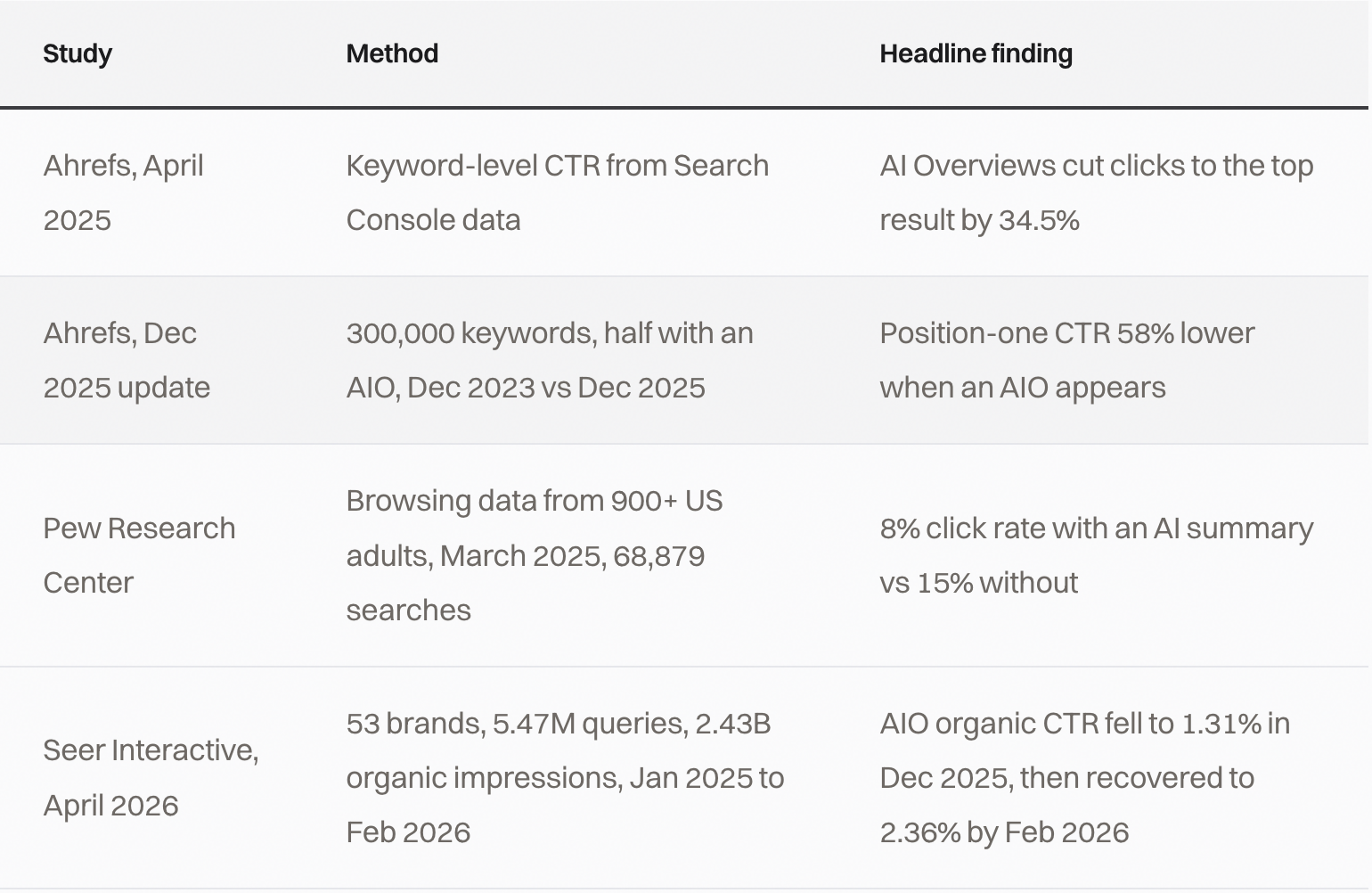
Presenc AI rounded up the main studies on what Google’s AI Overviews do to clicks. Ahrefs found the top result loses 58% of its clicks when an Overview sits above it, easing to about 19% by position ten. Pew found people clicked a regular result on 8% of searches with an AI summary versus 15% without, and clicked links inside the summary just 1% of the time.
The 2026 numbers are probably more useful. Seer Interactive found click-through on Overview queries bottomed out at 1.31% in December 2025 and climbed back to 2.36% by February, still short of 3.82% on queries without one. Brands cited inside the Overview got roughly 20,700 clicks per million impressions versus about 9,400 for those that weren’t. That’s more than double.
The Takeaway
To paraphrase Mark Twain, rumours of SEO’s death have been greatly exaggerated. Ranking first organically used to be the holy grail, and unsurprisingly, that’s fading. An uncited number one result now gets fewer clicks than a cited one further down, so your rank tracker is telling you less than it used to.
Presenc sells AI visibility monitoring, so it’s got a point of view (so does everyone writing these reports, tbh), but the numbers come from Ahrefs, Pew and Seer and they all point the same way.
So what’s the game now? I think it’s shifting from being found to being chosen. For twenty years the job was to rank and win the click. Now an AI reads everything said about you and builds the shortlist itself, and you may never know if you made it. That’s harder to measure, and much harder to fake.
📈 WPP Media Reveals 75% Of Aussies Are Using AI Search To Help Make Purchase Decisions, B&T

The Rundown
The first article was about lost clicks. This one’s about where the decision went. WPP Media surveyed 2,500 Australians across 12 categories in August, and three in four already use AI search to help decide what to buy: 58% via AI summaries in regular search, and 40% going straight to ChatGPT, Gemini or Claude. Usage runs from 36% in pet care to 87% in financial services.
WPP calls it a hidden pathway: the shortlist forms before a marketer sees a thing. 94% of AI use happens early in the journey, 61% discovered brands they hadn’t considered, and 26% completely changed a planned purchase after an AI recommendation. 82% trust a brand more when it shows up in AI results, and 66% have used AI to fact-check an ad. WPP’s Daniel Benton says brands need to be “not only visible, but understood, credible and genuinely recommendable.”
The Takeaway
The 66% who fact-check ads is what jumped out at me. Your customers have a second opinion on tap now, and it’s read everything the internet says about you, not just your homepage.
Usual caveat: WPP is a media agency, so of course the answer involves your media plan, and it’s self-reported survey data. But it lines up with the click data in the first article.
It’s great when an AI recommends you. The catch is it can shortlist you, vouch for you or quietly drop you (AI ghosting?) without anyone visiting your site, and your PostHog data won’t show a thing. If what’s out there about you is thin or contradictory, the AI fills in the gaps, usually in favour of whoever has the bigger footprint. Word of mouth is back, it’s just AI doing the recommending now.
Inside the race to get recommended by AI: The business directory cracking the code, SmartCompany
The Rundown
My favourite story of the month. In September, Perth agency Search Scope logged 2,400 AI responses across 20 industries. After Google and Reddit, the most-seen domain was Starworks, a directory you’ve probably never heard of, with 199 appearances, ahead of ProductReview, Word of Mouth and hipages. Victorian agency Dossis Digital spotted it in June too.
Starworks is run by Ben Adler, a 17-year-old Melbourne student. He noticed crawlers taking an interest around March and tinkered with site structure until Starworks was being recommended for tradies, cleaners and florists. His advice is old school: mentions on other sites, a strong Google Business Profile, genuine reviews and directory listings. And he admits ranking on ChatGPT “can’t really be done 100% reliably.”
The Takeaway
Hats off to a 17-year-old for working out what agencies charge good money for. But it’s also a bit unsettling that a months-old directory can become a go-to AI source for Aussie local services, and Adler himself admits it can be gamed. The platforms are clearly still figuring out who to trust.
It’s also a good reminder that AEO and SEO aren’t the same game. A 2026 study of 11,500 queries found the sources surfaced by Google Search, AI Overviews and Gemini had just 11% to 18% similarity.
And no, this isn’t your cue to build a directory network (or maybe it is). AI recommends you based on what others say about you, which makes getting listed, reviewed and mentioned part of go-to-market now. The funny thing is none of this is new. It’s reputation, just with a different audience reading it.
The ultimate guide to AEO: How to get ChatGPT to recommend your product | Ethan Smith (Graphite), Lenny's Podcast
It’s from September 2025, which is basically ancient in AI years, but it’s still the clearest AEO primer I’ve found. Lenny Rachitsky sits down with Ethan Smith, CEO of SEO agency Graphite, about getting your product recommended by ChatGPT, Claude, Gemini and Perplexity.
He makes a massive claim that ChatGPT traffic converts six times better than Google. Graphite sells this stuff, so grain of salt, but it does fit WPP’s finding that the shortlist forms before anyone lands on your site. The good news for founders is that early-stage startups can show up in AI answers almost straight away, without the years of domain authority SEO needs.
His three go-tos are landing pages, YouTube videos and authentic (not spammy) Reddit comments. He’s big on help-centre content too, and blunt that AI-generated content doesn’t work (no shortcuts there, sadly).
Short on time? Watch 11:51 to 21:41, then the playbook at 28:55.
Additional Resources
If you’d rather roll up your sleeves than just read about it, our September Lunch & Learn is a good place to start (shameless plug, I know).
Lunch & Learn: How to Get Found by AI, Cremorne Digital Hub
Darren Huang sat down with Lucia Kim, founding member of technical staff at Inflect, to unpack GEO for founders. They cover how AI platforms choose what to cite, why Reddit and YouTube punch above their weight, and how to measure AI referral traffic beyond Google Analytics. If you only watch one bit, skip to 21:00, where Lucia walks through five technical basics worth checking today (llms.txt, robots.txt, sitemaps, noindex tags and JSON-LD schema). And stick around for the Q&A, which gets into Reddit bans, sponsored AI placements and non-English queries.