Welcome back to Innovation Download, our monthly round-up of what's worth reading if you're building a startup in Australia.
This month we're digging into GTM, and how little has actually changed in the age of AI. It's come up in a lot of conversations around the community lately. AI has made it a lot easier to build a product (yes, I know there's lots of slop out there), but finding customers is still the hardest part of running a startup.
So this issue looks at both sides of that. Kyle Poyar makes the case that your GTM edge now comes from the customer data you already own, not from finding a new channel. It's an interesting case, and well worth reading. Revenue Leaders ask whether cold calling still holds value. Jen Abel shares her enterprise sales playbook on Lenny's Podcast for anyone past their first few customers (surprise, surprise, it's mostly the fundamentals done well). And we finish with one of our own resources on staying visible now that buyers are asking AI to do their research.
Here's what's worth knowing this month.
-Alan Tsen
This Month's Reads
The New Battleground in GTM, Kyle Poyar
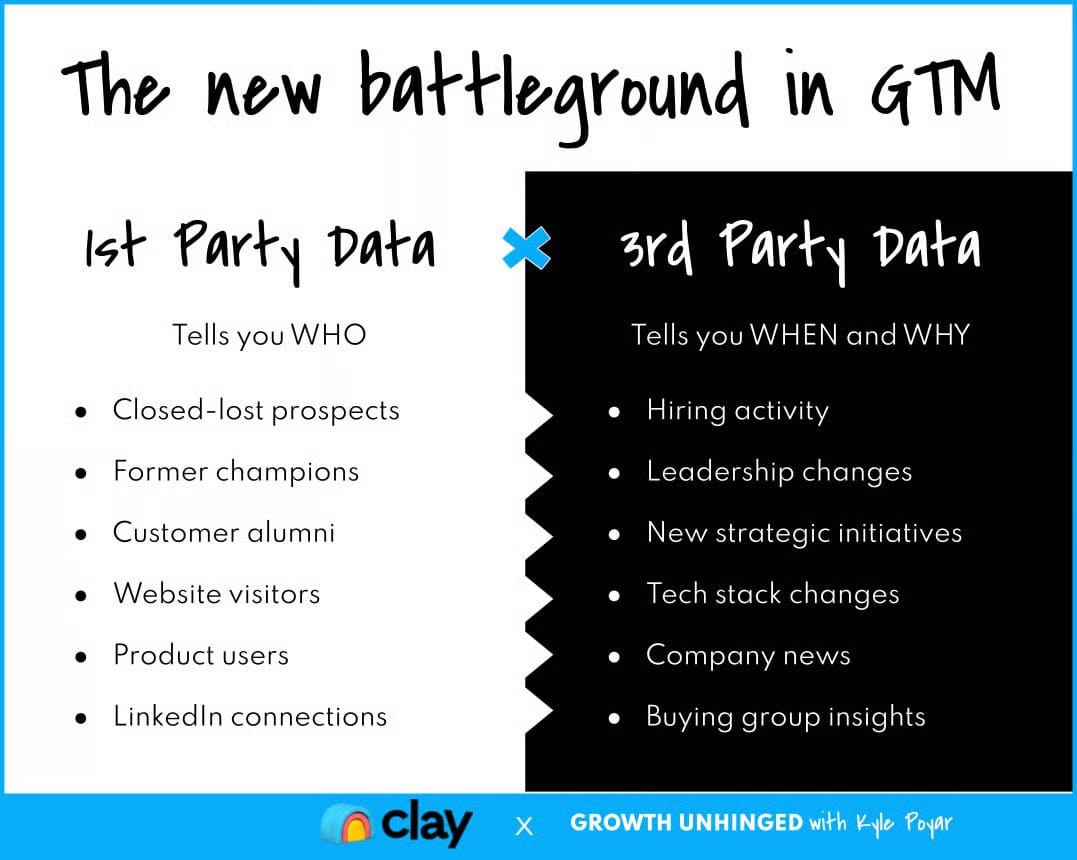
Rundown
For a long time, the thinking in GTM circles was that your edge came from finding a channel nobody else had cracked yet. Kyle Poyar reckons that's not really true anymore. Bought intent data (the stuff every vendor sells you) is basically table stakes now, because everyone's using the same signals. He argues that the real edge comes from mixing that with your own first-party data. He runs through a few "agentic" plays built on this, like pinging former users 30 days after they change jobs, or jumping back into a closed-lost deal the second the champion there leaves for a new company. His view is that you should stop hunting for new channels and start paying attention to who's already waving at you.
Takeaway
You don't need a slick AI stack to get value out of this one. The useful bit here is the mindset shift. The customer data you're already sitting on (signups, usage, who went quiet on you) is a GTM asset that we all tend to forget about, and most of it only ever gets a glance in a dashboard. Most early founders ignore this stuff until someone tells them to "sort out the CRM." But some of your best pipeline might be old trial users who changed jobs, or champions who ghosted you. A spreadsheet and a habit of checking LinkedIn for job moves among past leads gets you most of the way there. Worth filing away for later even if you're not there yet.
“Cold Calling Is Dead”… The Reality of Cold Calls in 2026 | Sales Outreach, Revenue Leaders
Rundown
Every year someone declares cold calling dead, and this episode pushes back on that a bit. But what I think is more interesting is what it says about channel choice in your overall GTM strategy. Their argument is that cold calling is a motion rather than a strategy, and it only earns its place in your GTM mix when the timing, relevance and attitude are right. Run as a generic high-volume cadence it's dead weight, but as one deliberate lever inside a broader plan it still converts. They dig into what makes a buyer take a meeting now instead of pushing you to "next year," and argue that reps chasing volume over targeting have given the channel its bad name. There's also a solid timing point about using the quiet end-of-year stretch to get ahead on next year's pipeline while most competitors have mentally clocked off.
Takeaway
Good one to pair with the Kyle Poyar piece, since both are arguing that precision beats volume (read as: do less, better), whichever channel you're on. For founders, the real value is the time it should save you. Early stage, you don't have the headcount to run a big outbound machine, so you have to be somewhat deliberate with the outbound work you do. Call fewer people and know exactly why you're calling each one, and you'll spend your limited hours on the accounts worth chasing instead of burning through a list. That's a founder-time problem as much as a sales problem. The other practical one here is treating the last few weeks of the year as an opening. While competitors have checked out, a well-researched call has far less noise competing with it, so you can build next year's pipeline while everyone else starts from zero in January. If you're doing your own outbound and wondering whether picking up the phone is still worth the time, the answer here is yes. Just standout,
Once that well-targeted call hits, the next question is what you say when you're in the room. That brings us to a personal favourite for anyone trying to build a sales motion that doesn't depend on the founder.
84 minutes of enterprise sales alpha | Jen Abel, Lenny's Podcast
Rundown
Jen Abel gets into what works once you're past founder-led first deals and trying to build a repeatable enterprise motion. Her big idea is to stop pitching your product as a problem solver and pitch the upside, the "alpha," of working with you instead. Loads of practical detail in here too. A healthy enterprise win rate is 25 to 35%, and if yours is higher your pricing's probably too low. Which is a super interesting take. The most valuable moment in the whole cycle is the first intro call, not the demo. And when you do demo, show only the 20% of the product the buyer cares about, built with your champion beforehand rather than sprung on them cold.
Takeaway
This one's the most tactical of the three, and probably the most immediately useful if you're moving past your first few customers. The bit that I like most in this podcast is her point on vision casting versus problem solving. Founders love proving they "get" the buyer's pain, but senior enterprise buyers respond far more to seeing where they could be than to hearing their current problem repeated back to them. Another good habit to steal is texting your champion for a raw debrief five minutes after a demo wraps, while their gut reaction is still fresh and unfiltered. If you're doing sales calls, it's worth the full listen, not just the highlights.
Additional Resources from CDH
We've talked a lot in this issue about picking up on buyer signals, whether that's watching who's changed jobs or timing a well-researched call. Something is shifting on the other side of the table too, with buyers increasingly asking AI tools to do their research before they ever land on your site. So the last resource this month is one of our own, on making sure you're visible when AI is doing the searching. Huge thanks to Lucia Kim for sharing her insights!