Welcome to The Monthly Signal
Welcome to The Innovation Download — a monthly read on what’s shifting in Australia’s startup and innovation ecosystem, and what it means for people building inside it.
This isn’t a link dump. Each issue pulls together a small set of signals worth paying attention to, then does the harder part: translating them into practical implications for founders, operators, investors, and ecosystem leaders.
This is our first issue for 2026, and this month's theme feels hard to ignore: Substance over Speed.
It’s easier to build than ever. Thanks to AI, you can prototype a product in a weekend, generate a brand in an afternoon, and spin up a pitch deck in an hour. The surface area of “done” has expanded — and so has the volume of work that looks finished but doesn’t survive contact with reality: unclear positioning, brittle systems, messy handovers, governance gaps, and experiences that feel polished until a real user tries to rely on them. Gradient AI design slop anyone?
That’s why advantage is shifting. Not to the teams who can produce the most (or just the fastest), but to the ones who can turn speed into something durable: products that feel coherent, operations that run cleanly, and decisions that are obvious to the next person who has to execute them.
In Australia, this compounds quickly. It’s a smaller market with long memories. Buyers are cautious, especially in enterprise and government. Credibility is earned through execution, integration, and trust. Speed still matters — but the teams that pair it with craft, clarity, and real-world rigour will keep pulling ahead.
Stories On Our Radar
Gen Z won’t settle for boring design. Here’s what it means for the future of work (Canva)
Canva’s research finds that most Gen Z workers prefer visual communication over text, yet many workplaces still rely heavily on written documents and linear processes. The article outlines how this mismatch affects comprehension, collaboration, and productivity, drawing on survey data and workplace examples to illustrate the gap between modern communication preferences and current organisational practices.
Video Credit: Canva
Takeaway: The real implication is structural, not generational. Visual communication reduces cognitive load, shortens feedback loops, and accelerates decision-making, while text-heavy systems quietly slow organisations down. Teams that treat visual thinking as a core operating capability gain speed and alignment. Those that don’t accumulate friction, misinterpretation, and delay. This is not about aesthetics. It is about how efficiently work moves from idea to execution.
Government's New AI Plan (The Saturday Paper)
The Albanese government has released its National AI Plan, pivoting Australia’s approach to artificial intelligence toward an “opportunity first” model that largely relies on self-regulation rather than a standalone AI law. The plan emphasises building an AI-enabled economy, leveraging existing consumer protection and privacy laws instead of prescribing new, overarching legal guardrails, and encouraging voluntary transparency and best practices for businesses deploying AI.
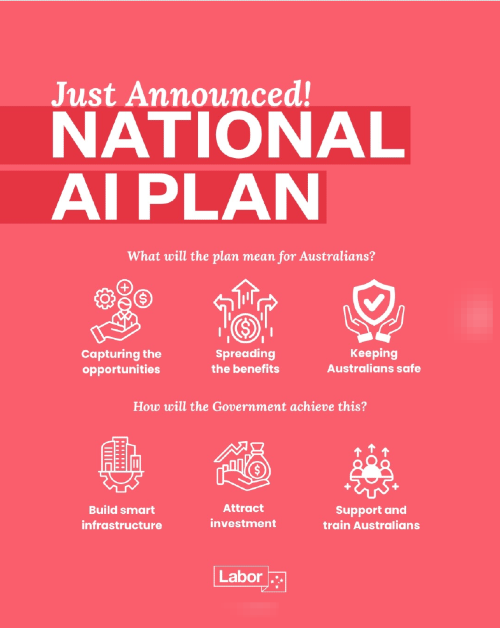
Takeaway: Australia’s decision to lean on self-regulation makes it easier to build and ship AI, particularly for large companies and fast-moving teams that are comfortable operating in grey areas. By avoiding hard rules, the system prioritises speed and flexibility, but shifts responsibility away from government and onto individual organisations to decide what is acceptable.
This rewards those with the resources and appetite to move first, while leaving smaller, more cautious teams waiting for norms to form. In practice, innovation accelerates, but accountability becomes uneven, defined less by law and more by who is willing to take on risk.
Leverage has shifted to the builder (Startup Daily)
The roles rising fastest in Australia are not purely technical or purely creative. They sit at the intersection of capability, risk, and execution. Alongside AI engineers and directors of AI, the job market is dominated by roles responsible for regulation, safety, governance, partnerships, and delivery. Mechanical engineers, power system engineers, legal and regulatory roles, and organisational leaders feature prominently.
What stands out is that as technology accelerates, so does the demand for people who can stabilise, integrate, and operationalise it. Innovation is expanding, but so is the need to manage complexity, risk, and real-world impact.
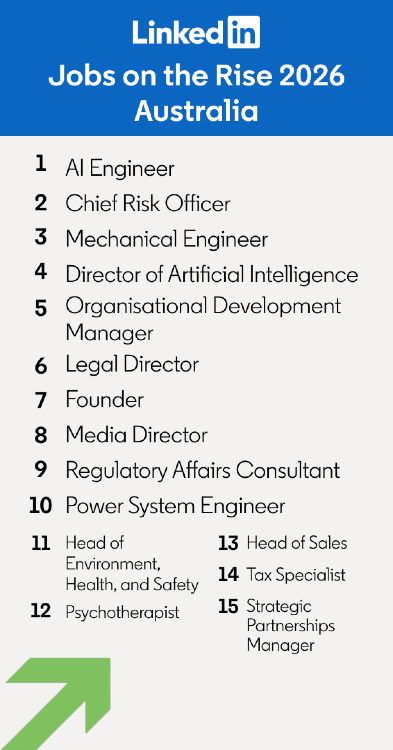
Takeaway: The market has already shifted toward builders. What matters now is who can make progress safely, legally, and at scale. As tools become more powerful and accessible, value is moving away from creation alone and toward translation. It’s easy to build quickly. Much harder to integrate that work into systems organisations can actually run. Execution, governance, and integration are no longer supporting functions. They are central to growth. The future of work isn’t just about unlocking new ideas and capability. It’s about making that capability compliant and sustainable in the real world.
Podcast Episodes Worth Your Time
Dialectic #35: Brie Wolfson - Loving Attention & Ease in Craft
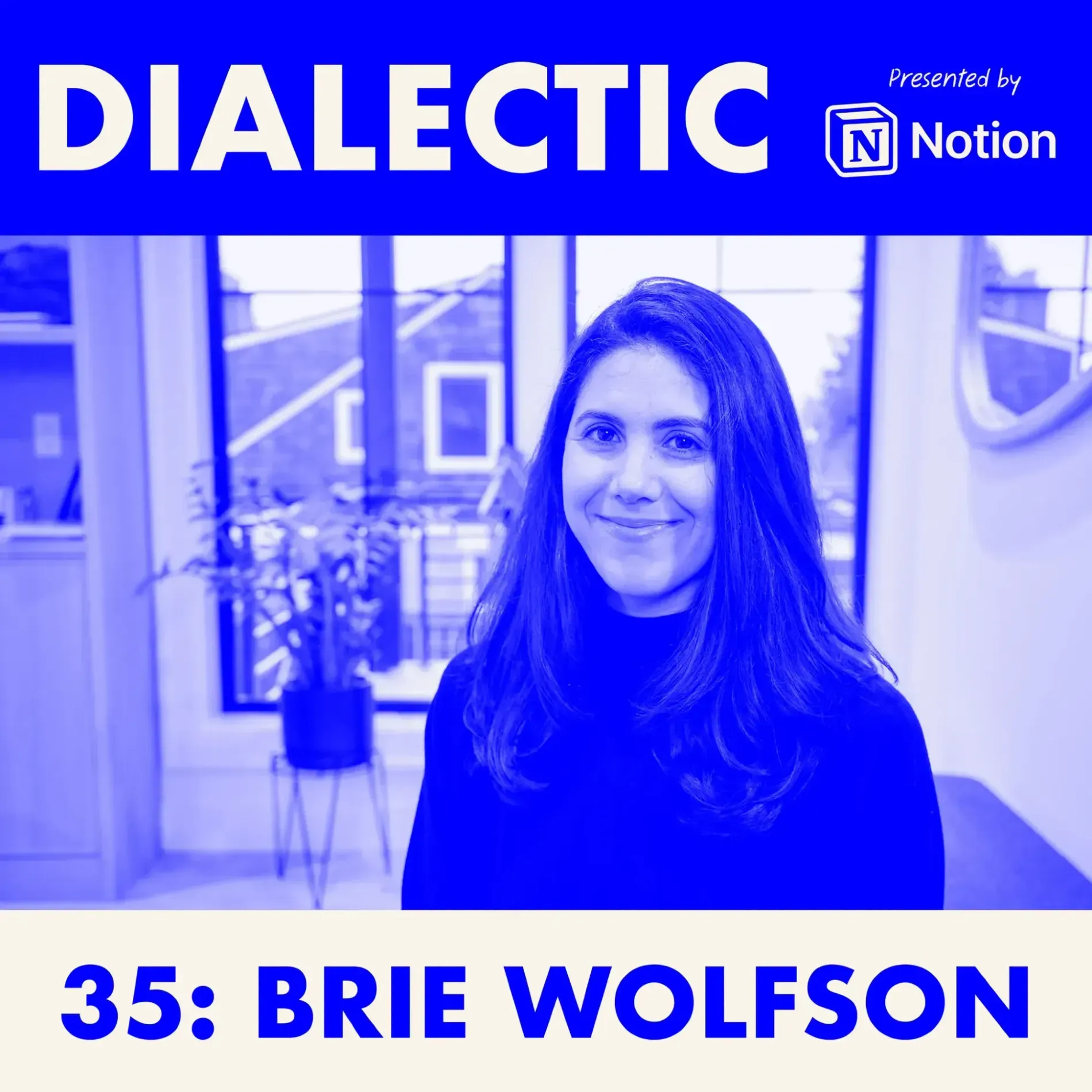
Brie Wolfson, the Head of Employee Experience at Cursor, spends much of this conversation reflecting on the role of craft in building.
Craft is usually associated with physical objects. A well-made chair. A solid table. Something you can inspect, feel the weight of, and trust because of the care that’s gone into it. In technology, craft is harder to point to, but no less real. It lives in how something feels to use. The clarity of an interface. The coherence of an experience. The way an article reads, an app responds, or a workflow holds together without friction. It’s not always visible, but it’s immediately felt.
Brie returns to the idea that this kind of judgement can’t be rushed or outsourced. It’s developed through doing. Through iteration. Through paying attention and calibrating taste over time. Advanced tools make it easier to produce quickly, but they don’t shorten the path to discernment. If anything, the standards are raised as a result.
This is where expectations often break. Moving fast is attractive, but quality product usually takes longer than you think. What's needed is often more thought. More care. More attention. Craft isn’t about slowing down. It’s about building with enough focus and patience to develop that je ne sais quoi. The "finger feel" of excellence that tells you something is truly well made, even if you can’t quite explain why.
Helpful Resources:
💻 Free Replit Vibe Coding Guide
💻 Lovable's Ultimate Prompt Guide
💻 12 Rules to Vibe Code Without Frustration by Peter Yang
📤 The Ultimate Cold Email Guide for 2024 by Yurii Veremchuk