There's a version of a tech event where someone shows you a product, tells you it's the future, and leaves you with a slide deck and a promo code. Last Thursday's evening at Cremorne Digital Hub wasn't that.
We had the pleasure of hosting Alex Dam, Notion's APAC Startup Lead and former VC, for a two-part evening that was equal parts practical and candid. The room was full of founders, operators, and small team leads. What followed was an hour of live demos, honest conversation, and a few genuine "wait, it can do that?" moments, before the evening opened up into something broader.
Here's everything that happened — and what you can take from it.
Part One: The Workshop
Alex was hosted by Darren Huang, our Community and Memberships Coordinator, and we were joined by Tim Jeffries, Certified Notion Consultant and Founder of Smooth Ops Consulting, for a hands-on deep dive into Notion's new agentic AI updates. The group built a live investor CRM from scratch, using the Notion's new agent product to populate records and surface contact details in real time.
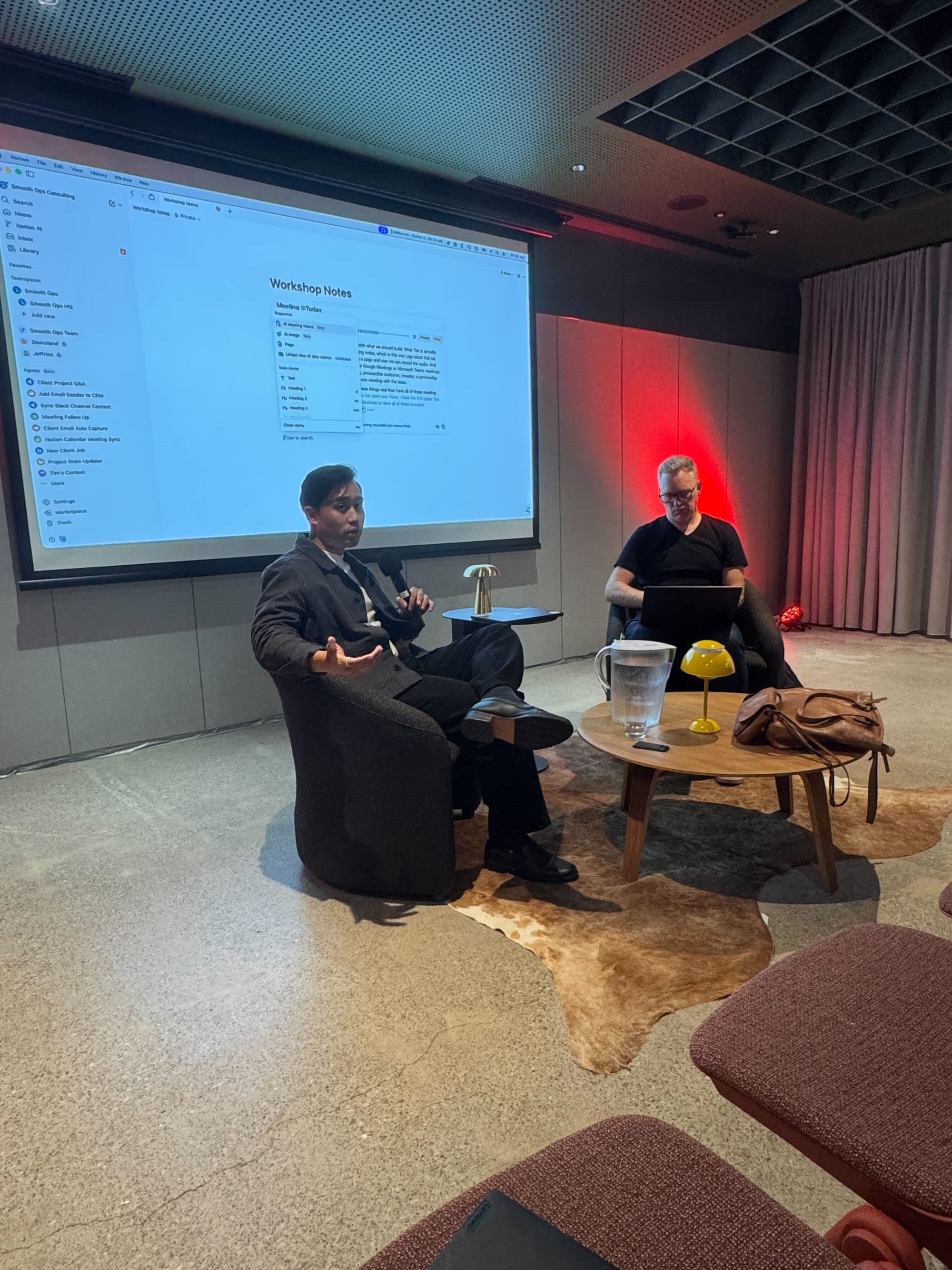
From Chatbot to Custom Agent
If you've used Notion AI before, you're probably familiar with the chat experience — you ask a question, and it responds based on whatever page you're on. Custom agents flip that dynamic entirely. Instead of waiting to be asked, they monitor your workspace and act autonomously based on triggers: a database property changes, a meeting ends, or a checkbox gets ticked. The analogy that resonated best in the room was this — the old model is like tapping an assistant on the shoulder every time you need something. Custom agents are like hiring someone who watches your systems, notices when something needs attention, and handles it without being asked.
What We Built — and What It Takes
AI is only as good as the context you give it, and in Notion, that context lives in your databases. Not spreadsheets, but smart lists that talk to each other across your workspace. A Projects database connects to Tasks, connects to Meetings, and connects to your CRM. That web of relationships is what gives an agent something real to act on. Building a live investor CRM in the room made this concrete: what might take hours of manual research was done in minutes, with the agent populating records, surfacing contacts, and flagging duplicates for human review, all from a standing start.
From there, the workshop walked through how custom agents are actually configured: defining a purpose, setting permissions, choosing a trigger, and chaining multi-step instructions in sequence. A meeting processing agent, for example, reads the transcript, extracts action items, creates tasks, assigns them, and updates the relevant CRM record without anyone touching anything. The practical tip that stuck was to prompt your agent to draft its own operating instructions first. A super useful tip.
Part Two: The Fireside Chat
After the workshop wrapped, Alan Tsen, our General Manager, sat down with Alex for a more personal conversation. It was a chance to hear directly from someone who's sat on both sides of the table, as an investor and now as an operator, on what's actually changing, and what isn't in startup land.
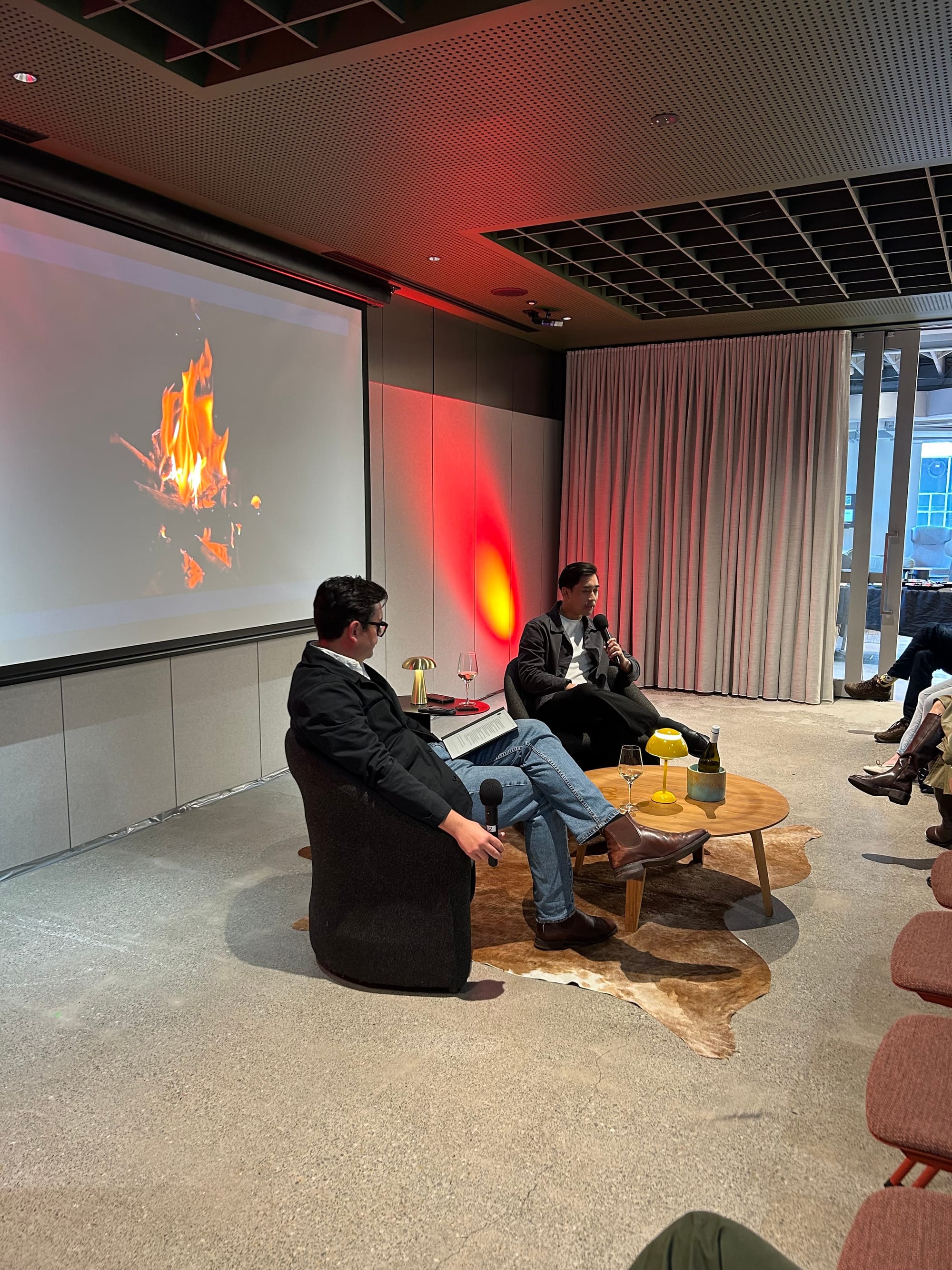
During the conversation, Alex spoke about why he made the move from investor to operator. Unsurprisingly, one of the major reasons he moved to the other side of the table was that he genuinely loved what Notion had built.
On Notion's place in the market, two things stood out. First, the Australian expansion wasn't a top-down push. It was a response to over two million users who were already here before Notion officially launched in the market. Second, Notion deliberately chose to go beyond project management as a category by adopting a "Lego box" approach rather than a finished kit with instructions on the lid. That restraint is what keeps the platform's ceiling high, allowing users to build a product that suits their needs in a flexible way.
Some Insights Worth Taking With You
→ It's harder than ever to build a successful SaaS business. The differentiator now isn't features — it's brand, content, and how you show up in the market. Building in public, creating content, owning a narrative — Alex sees this as the real moat for the next generation of SaaS companies.
→ AI makes it dangerously easy to hoard data nobody ever uses. Transcripts that pile up. Meeting notes that never get read. The risk isn't that AI does too little — it's that it produces so much that none of it gets acted on.
→ Australian founders move fast, think globally from day one, and carry a balance of humility and sales confidence that translates well in the US market. An underrated edge.
→ Enterprise search is one of the most overlooked AI use cases. The ability to instantly surface the right information from across your tools saves real time every day. Unglamorous, but compounding.
→ When asked for a contrarian belief, Alex said he's extremely bullish on voice dictation — not as a future trend, but right now. Faster, more accurate than typing, and almost nobody is using it seriously yet.